Entry in What 'Full Coverage' Car Insurance Actually Means
Do You Need Uninsured Motorist Coverage If You Have Full Coverage?
Learn how uninsured motorist coverage works alongside collision and comprehensive, why collision leaves medical gaps, and how state uninsured rates affect risk.

By Chris Delgado · Editor
Published
Answer in brief
While full coverage car insurance bundles liability, collision, and comprehensive protections, it does not automatically pay for your medical bills or lost income if an uninsured driver hits you. Collision pays strictly for vehicle repairs minus your deductible, leaving personal injury expenses unprotected unless you carry uninsured motorist coverage or dedicated medical benefits. In states where uninsured driver rates exceed 20%, keeping both coverages provides essential financial protection.
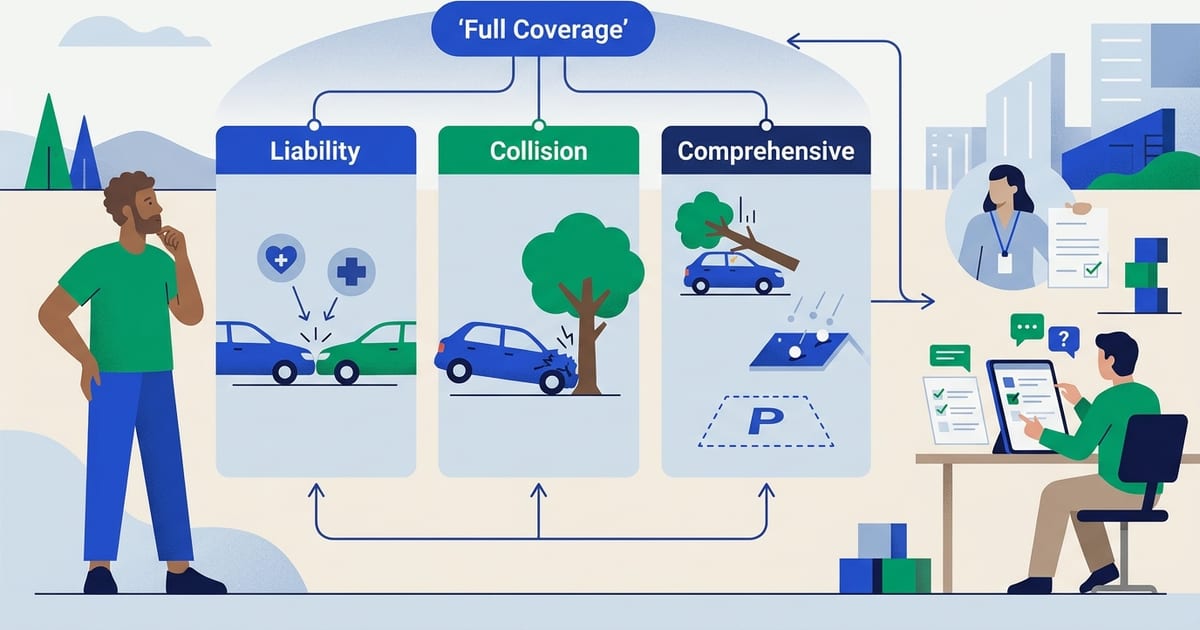
Many drivers assume that purchasing full coverage car insurance provides an impenetrable shield against any road mishap. However, in the insurance sector, "full coverage" is an informal term rather than a standardized legal contract. It typically describes a policy combining mandatory liability coverage with optional physical damage coverages: collision coverage and comprehensive coverage.
If an uninsured motorist strikes your vehicle or leaves the scene of an accident, collision coverage will pay to repair or replace your vehicle up to its actual cash value, after you pay your chosen deductible. What collision coverage will never do, however, is pay for your hospital visits, ambulance transportation, rehabilitation therapy, or lost income resulting from the crash. That critical shortfall is precisely why uninsured motorist protection remains vital even when you already pay for physical damage insurance.
Comparing Collision, Comprehensive, and Uninsured Motorist Coverages
| Protection Feature | Collision Coverage | Comprehensive Coverage | Uninsured Motorist (UM/UIM) |
|---|---|---|---|
| Repairs to your vehicle after a crash | Yes (regardless of fault) | No (covers non-collision events) | Yes (if UMPD is selected) |
| Standard deductible required | Yes (typically $500 to $1,000) | Yes (typically $100 to $500) | Often lower or zero depending on state rules |
| Driver and passenger medical bills | No | No | Yes (under UM Bodily Injury) |
| Compensation for lost wages and pain | No | No | Yes (under UM Bodily Injury) |
| Protection during hit-and-run incidents | Yes (subject to collision deductible) | No | Yes (subject to state statutory limits) |
As outlined by the Insurance Information Institute, basic auto policies divide protection into distinct buckets. Collision and comprehensive cover physical damage to the policyholder's vehicle, whereas liability and uninsured motorist coverages address legal liabilities and bodily injuries. Conflating collision with uninsured motorist protection leaves substantial financial exposure on the bodily injury side.
The Medical Expense Gap in Collision Coverage
When an at-fault driver has valid liability insurance, their bodily injury liability coverage pays your medical expenses, ongoing physical therapy bills, and lost earnings. When an at-fault driver is uninsured, you cannot turn to their policy. Your collision coverage will process the auto body shop invoices, but it cannot remit a single dollar toward your healthcare expenses.
Uninsured motorist bodily injury (UMBI) functions as a surrogate policy for the absent insurance of the responsible driver. It compensates you and your passengers for medical treatments, long-term disability, and funeral costs. While personal injury protection (PIP) or medical payments coverage (MedPay) can assist with immediate clinical fees in certain jurisdictions, their limits are frequently modest compared to the extensive protection provided by comprehensive UMBI limits.
How State Uninsured Rates Shape Your Crash Risk
The probability of encountering a driver without insurance varies drastically across state lines. Research compiled by the Insurance Research Council and published by the Insurance Information Institute reveals wide disparities in uninsured motorist rates across the United States. In 2023, Mississippi recorded the highest rate in the country at 28.2%, followed closely by New Mexico at 24.1%, the District of Columbia at 23.1%, Michigan at 22.3%, Florida at 20.6%, and California at 20.4%. Conversely, Maine recorded the lowest uninsured motorist rate at just 5.7%.
In states where more than one out of every five vehicles on the road lacks coverage, relying solely on collision coverage creates serious financial vulnerability. Even in Texas, where the uninsured rate sat at 14.5% in 2023, the likelihood of an uninsured collision remains high enough to warrant robust uninsured motorist endorsements.
Deductible Advantages: Collision vs. Uninsured Motorist Property Damage
Beyond medical coverage, uninsured motorist property damage (UMPD) offers distinct deductible advantages over standard collision policies. When you file a vehicle repair claim under collision coverage, you must pay your selected deductible—often $500 or $1,000—out of pocket before the insurer issues payments. While your insurer may attempt subrogation to recover your deductible from an at-fault driver, recovery from an uninsured person is rarely successful.
In jurisdictions where UMPD is offered or mandated, the statutory deductible is frequently lower than collision deductibles, and some states waive the deductible entirely when an uninsured motorist is identified in an official crash report. Carrying both coverages allows your claims adjuster to assign the property loss to the coverage that minimizes your out-of-pocket costs.
Step-by-Step: How to Audit Your Policy for Coverage Gaps
- 1
Review your policy declarations page
Examine the declarations document to verify whether you carry Uninsured Motorist Bodily Injury (UMBI) and Uninsured Motorist Property Damage (UMPD) alongside your collision and comprehensive lines.
- 2
Match UM limits to your liability limits
Insurance consumer guidance advises matching your uninsured motorist bodily injury limits to your bodily injury liability limits, ensuring you protect yourself to the same extent you protect strangers.
- 3
Examine health insurance deductibles and limits
Calculate your personal health insurance out-of-pocket maximums and copays. If your health coverage includes high deductibles or restrictive provider networks, higher UMBI coverage is crucial.
- 4
Compare competitive multi-line quotes
Adding uninsured motorist coverage to an existing full coverage policy typically represents a small fraction of the total annual premium. Shop multiple insurers to see how pricing varies across carriers.
Questions & answers
Can I rely on collision insurance if a hit-and-run driver hits my car?
Yes, collision insurance pays to repair vehicle damage caused by a hit-and-run driver, subject to your collision deductible. However, collision will not pay for any injuries or medical treatment you or your passengers sustain during the crash.
Does uninsured motorist coverage duplicate collision coverage?
No. While Uninsured Motorist Property Damage (UMPD) and collision both address vehicular damage, UMPD often features lower statutory deductibles. More importantly, Uninsured Motorist Bodily Injury (UMBI) protects against medical costs and lost wages, which collision never covers.
Why is uninsured motorist coverage optional in some states if so many drivers lack insurance?
Each state's statutes set mandatory minimum insurance standards. While some states require uninsured motorist coverage by law, others allow policyholders to reject it in writing, leaving the decision to individual financial evaluation.
How much does adding uninsured motorist coverage usually cost?
Because uninsured motorist coverage is secondary to primary liability and collision lines, adding it to a full coverage package typically represents an incremental premium adjustment of under 10% to 15% of your overall annual policy cost.
Terms: Full coverage, Collision coverage, Comprehensive coverage, Deductible, Actual cash value (ACV)
Sources and references
Legal figures on this page (minimum limits, filing periods, statutory benefits) are checked against the primary law or the state insurance regulator listed below. Links and figures last verified Nov 2026.
- 14 percent of U.S. drivers were uninsured in 2022 — Insurance Research Council (2023)Independent researchAbout one in seven drivers was uninsured in 2022; highest D.C. 25.2%, New Mexico 24.9%, Mississippi 22.2%; lowest Wyoming 5.9%, Maine 6.2%, Idaho 6.2%. Method: ratio of UM to BI claim frequencies.
- Estimated percentage of uninsured motorists by state, 2017–2023 — Insurance Information Institute (2025)Statistical dataIRC time series by state; 2023: Mississippi 28.2%, New Mexico 24.1%, D.C. 23.1%, Michigan 22.3%, Florida 20.6%, California 20.4%, Texas 14.5%; lowest Maine 5.7%.
- 2019–2023 Auto Insurance Database: average premium supplement — National Association of Insurance Commissioners (2025)Statistical dataCountrywide average expenditure $1,281 in 2023 (+13.98%); combined average premium $1,438; state tables for liability, collision and comprehensive.
- Facts + Statistics: Uninsured motorists — Insurance Information Institute (2024)Statistical dataInsurance Research Council estimates of uninsured drivers by state (2022: e.g. Michigan 19.6%, California 17.0%, Florida 15.9%, Texas 13.8%).
- What is covered by a basic auto insurance policy? — Insurance Information InstituteConsumer guidanceDefines bodily injury and property damage liability, MedPay, PIP, uninsured/underinsured motorist, collision, comprehensive and glass coverage.
- How much auto coverage do I need? — Insurance Information InstituteConsumer guidanceWhy state minimums are a floor; choosing liability limits that protect assets; when collision and comprehensive are worth keeping.
- Understanding your insurance deductibles — Insurance Information InstituteConsumer guidanceHow deductibles apply to collision and comprehensive and how raising them lowers premium.
- How to file an auto insurance claim — Insurance Information InstituteConsumer guidanceSteps after a crash: document the scene, notify the insurer promptly, understand the adjuster's role.
Practical guidance on this page is original editorial work. Cited sources support factual statements and do not endorse this site. Dollar ranges described as typical or illustrative are editorial estimates, not figures from these sources.