Guide
Full Coverage Cost by Vehicle Type
How insurers price collision and comprehensive for sedans, SUVs, pickups, luxury, electric and sports cars—repair cost, parts, theft rate and model loss history.

By Chris Delgado · Editor
Published · Updated
Answer in brief
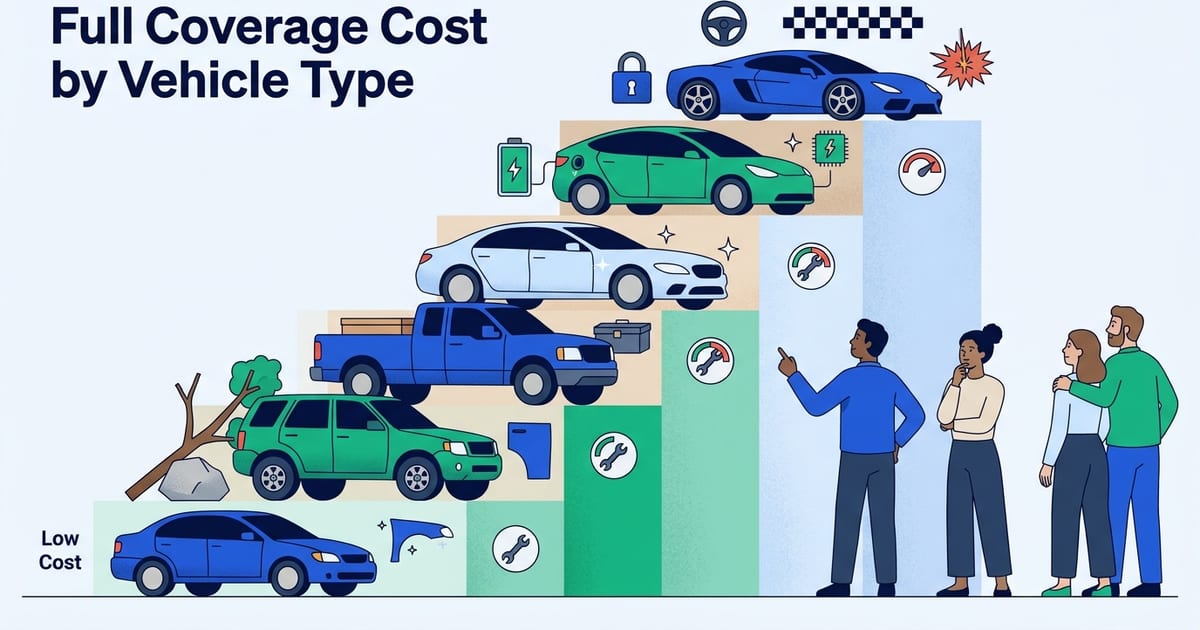
Collision and comprehensive are priced by model, using the insurer's own loss data and industry claim histories. Mid-size sedans, minivans and small SUVs are generally cheapest; luxury, sports and electric vehicles cost most because of parts prices, sensors, battery repair and higher claim severity. Pickups vary widely by trim. Before buying a car, quote it—two similarly priced vehicles can differ by $600–$1,200 a year in full-coverage premium.
| Category | Relative cost | Why |
|---|---|---|
| Minivan / family SUV | Low | Cautious drivers, cheap parts, low theft |
| Mid-size sedan | Low–medium | High volume, parts availability |
| Compact car | Medium | Higher injury claims, younger drivers |
| Full-size pickup | Medium | Varies by trim; theft on some models |
| Luxury sedan / SUV | High | Parts and sensor cost, repair labour |
| Electric vehicle | High | Battery repair, specialist shops, higher MSRP |
| Sports car | Very high | Speed-related claims, expensive parts |
What the insurer looks at
- Repair cost—parts prices, aluminium or carbon panels, sensor recalibration.
- Claim frequency and severity for the exact model and year.
- Theft rate for the model.
- Safety features that reduce injury claims (and sometimes repair claims).
- Price—actual cash value sets the maximum payout.
Before you buy
Get a full-coverage quote on each finalist vehicle. The difference between two cars with similar prices can exceed the difference in their monthly payments.
Questions & answers
What cars are cheapest to insure with full coverage?
Minivans, family SUVs and mid-size sedans with good safety records and cheap parts.
Why is electric car insurance higher?
Battery and sensor repair costs, specialist shops and higher purchase prices.
Does car colour affect insurance?
No. Make, model, year, trim and safety features do.
Terms used in this guide
- Vehicle symbol / rating group
- A model-level rating that reflects repair cost, theft and claim history; drives collision and comprehensive pricing.
- Collision coverage
- Pays to repair or replace your car after a crash regardless of fault, minus the deductible.
- Comprehensive coverage
- Pays for non-crash losses: theft, vandalism, weather, fire, animal strikes, glass.
Sources and references
Legal figures on this page (minimum limits, filing periods, statutory benefits) are checked against the primary law or the state insurance regulator listed below. Links and figures last verified Nov 2026.
- Advanced driver assistance — Insurance Institute for Highway SafetyIndependent researchEffectiveness of automatic emergency braking, lane departure and other systems in reducing claims and crashes.
- Insurance losses by make and model — Highway Loss Data InstituteStatistical dataRelative claim frequency and severity by vehicle under collision, property damage, comprehensive, PIP, MedPay and bodily injury coverages.
- Vehicle ratings — Insurance Institute for Highway SafetyStatistical dataCrashworthiness and crash-avoidance ratings by make and model.
- Top Safety Pick awards — Insurance Institute for Highway SafetyStatistical dataCurrent award winners; useful when choosing a vehicle for a new or young driver.
- How much auto coverage do I need? — Insurance Information InstituteConsumer guidanceWhy state minimums are a floor; choosing liability limits that protect assets; when collision and comprehensive are worth keeping.
- What is covered by a basic auto insurance policy? — Insurance Information InstituteConsumer guidanceDefines bodily injury and property damage liability, MedPay, PIP, uninsured/underinsured motorist, collision, comprehensive and glass coverage.
- Understanding your insurance deductibles — Insurance Information InstituteConsumer guidanceHow deductibles apply to collision and comprehensive and how raising them lowers premium.
- What is gap insurance? — Insurance Information InstituteConsumer guidanceGap coverage pays the difference between a car's actual cash value and the loan or lease balance after a total loss.
Practical guidance on this page is original editorial work. Cited sources support factual statements and do not endorse this site. Dollar ranges described as typical or illustrative are editorial estimates, not figures from these sources.
Guide
How Much Full Coverage Car Insurance Costs
Typical full-coverage premiums nationally and by driver profile, how much collision and comprehensive add, and the factors that move the price.
Guide
When You Need Full Coverage
Situations where collision and comprehensive are worth it: financed or leased cars, cars you cannot replace from savings, newer vehicles, high-theft and weather areas.
Guide
How to Compare Full Coverage Car Insurance Quotes
A method for comparing full-coverage quotes: fix coverages and deductibles, include the add-ons you want, gather several quotes, normalise to annual cost, and check lender requirements.